


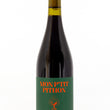
Olivier Pithon - 'Mon P'tit Pithon Rouge' - Grenache, Syrah, Mourvèdre - Calce, Côtes Catalanes, FR - 2023
Regular price $28.00
Unit price per
Special Orders
Want more than we have in stock? Get yourself a larger allocation! 2-case minimum applies in most cases. Availability, pricing and any discount are confirmed individually and may differ between retail, case and club price.
Submitting a request does not guarantee an order. When we receive your request we will check with our suppliers and confirm availability, price and any discount with you before anything is charged.
Request a Case OrderNotes from the Winery/Importer
A scrumptious and lively yet deep red from the hills of Côtes Catalanes: the magical transom between France and Spain. Absolutely vibrant.
///
I was introduced into the world of wine during my earliest years by my maternal grand-father in Anjou. I fell into it, as they say, when I was little. My older brother who is a wine-grower, settled into the Coteaux du Layon region (Jo Pithon) when I was only 4 years old. I have dozens of memories in his wine cellar… and only good ones!
It is therefore only natural that I chose to work with wine or perhaps rather that it chose me. From as young as 14 years old, I worked in vineyards as an apprentice in my home town, Anjou. Aware very early on about the importance of quality, I left my motherland at 18 years of age, to continue my training in the Bordeaux region.
A series of internships allowed me to discover other regions in France like the Jurançon and the Beaujolais. Once my studies finally came to an end, I was able to focus entirely on my passion for the land and for wine…
Experience after experience, five years went by working in the Bordeaux region (Saint-Émilion) expanding little by little my knowledge of the field.
Life saw to it that I would meet many people, one of whom was Stéphane Dereoncourt, a self-taught winemaker from the Bordeaux region.
With him I discovered sensitivity, how wines can become pleasurable, balance and lightness.
The love for a job well done, the close attention given to our interventions on the land, the importance of tasting to see the development of wines, and the respect for the raw materials.
It may seem silly, but these are things we aren’t taught at school… We never learn that the most essential thing is to make wines we love. Never do we talk in class about poetry, love and pleasure. Stéphane helped me realise all of that… Sometimes, an encounter can be life-changing.
Naturally (just like how it seemed natural to have a cow, a horse/mare and a dog for a balanced lifestyle) came a deep desire to spread my own wings and vinify my own vines.
At the end of 2000, I started the search for a place to live, a piece of land where I could live out my passion for earth and wine.
I was immediately captivated by Calce, in the Pyrenees-Orientales, as if there couldn’t be any other place for this adventure. Ever since one phone call and my meeting with Gérard Gauby (a friend of my brother), I have never turned back.
In as little as one month, I went from being unemployed to being a wine-grower, with paperwork for the bank replacing paperwork I had for the government benefit.
The unattainable dream of having one’s own vines, barrels, and wine had been achieved: a real fairy tale! The first day in my vineyard will stay forever engraved in my memory: the 3rd of January 2001. Calce.
Old Carignan planted by a certain somebody called Saturne in 1940. An unobstructed view of the Mediterranean, the Corbieres, the Pyrenees. Secateur in my hand. Head down. The adventure of my life was beginning.
Never in my young life would I have ever thought that this could be possible: having my own space, just for me, 8.5 hectares of old vines on slopes of schist hillsides. Not even in my wildest dreams was it so beautiful. A new life was beginning, my life, not the culmination but the beginning of a crazy adventure.
«Freedom I cherish your name !»
From then onwards, I have had a single desire: to give everything to my vines so that they can give back to me in grapes and wine.
Taking pride in giving it your heart and soul, your sweat, your love, your wishes, your dreams. Going organic was obvious to me, a marker of respect, a requirement for quality, a lifestyle choice.
Economically irrational for a young business such as mine, but being generous, natural and having integrity is all what I stand for.
Notes on the Producer
"I was introduced into the world of wine during my earliest years by my maternal grand-father in Anjou. I fell into it, as they say, when I was little. My older brother who is a wine-grower, settled into the Coteaux du Layon region (Jo Pithon) when I was only 4 years old. I have dozens of memories in his wine cellar… and only good ones!
It is therefore only natural that I chose to work with wine or perhaps rather that it chose me. From as young as 14 years old, I worked in vineyards as an apprentice in my home town, Anjou. Aware very early on about the importance of quality, I left my motherland at 18 years of age, to continue my training in the Bordeaux region.
A series of internships allowed me to discover other regions in France like the Jurançon and the Beaujolais. Once my studies finally came to an end, I was able to focus entirely on my passion for the land and for wine…"
Calce is a unique place located between the Mediterranean Sea, the Pyrenees mountain range and the Corbieres mountain range. Situated at about 300 metres altitude, the vines are positioned on extremely an rich terroir.
Soils: Marls, Schists and Limestone.
White grape varieties: Macabeu, Grenache Gris and Blanc.
Red grape varieties: Carignan, Grenache Noir, Mourvèdre.
Never have I ever second guessed myself, it is without a doubt and unthinkable for me to work the soil and vines other than with the upmost love and respect. We cannot say we respect the land while using products which have skulls marked on their bottles.
After several unsuccessful attempts, we are currently working with a biodynamic approach. Under the guidance of Jacques Mell (a biodynamics advisor) since 2010, we carefully apply biodynamic practices. He allowed us to understand and practice, as thoroughly as possible, this type of agriculture which is full of common sense and sensitivity. Today, I can better understand my vines, my soil and my terroirs. Working as closely as possible to the ground and the vine stocks allows me to make even more delicate and accurate wines.
Biodynamics
– The plant :
We use horn silica (501) in autumn and spring. In autumn, we use it to stimulate the return of sap in the roots and therefore preservation. Then it is used in springtime to reinforce the photosynthesis and to bring a luminous quality to the plants.
– The soil :
In autumn, we use a tiny dose of cowpat compost called Maria Thun to stimulate soil life. In springtime, we use a booster with a cow-horn manure (500) to stimulate the awakening of the soils.
I chose biodynamics with the palate in mind. When the point of commonality in your wine preferences is that they are all biodynamic, it is worth asking yourself why that is.
After many discussions and tastings, I made the leap to this agricultural practice which is an extension of organic agriculture, also being dynamic. Some of its basic principles are similar to homeopathy with regards to the dilution process and in its dynamisation. For me, it is a better way to showcase my terroirs and the qualitative potential of my vineyard.
I put ten years into bringing life back to the soils which the previous generation had killed. Today the soils are alive and expressive and biodynamics is there to enhance it. However, just like organic agriculture, biodynamics is simply a method, it is by no means a marker of quality. There are also biodynamic wines which I don’t enjoy.
Life and biodiversity
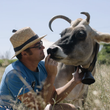
From the age of 25, I have shared my life with Lais. 25 years of communal life is beautiful. I have always loved cows, that is to say, the animal as a whole (especially those which are eaten). When I arrived in Calce with my cow and a mare, everyone asked me what on earth I was doing with all these animals. Today I have sheep grazing in the vineyard and the surrounding areas from October to April. We also have some beehives. For me agriculture is to be appreciated in all its glory, in its entirety.
We have planted a lot of trees and plan to redo the hedges around the plantations.
Planting
We have started to sow seeds in certain vineyards to reintroduce a permanent plant covering. A mix of grains and legumes is sown early in autumn so that there is plant cover all winter, which we will bury in the spring. We also add other organic matter to allow for continuous growth and life in the soil.